Tuesday, July 27, 2021

Vega(n) bites...

 ...for the tasty fat bass!

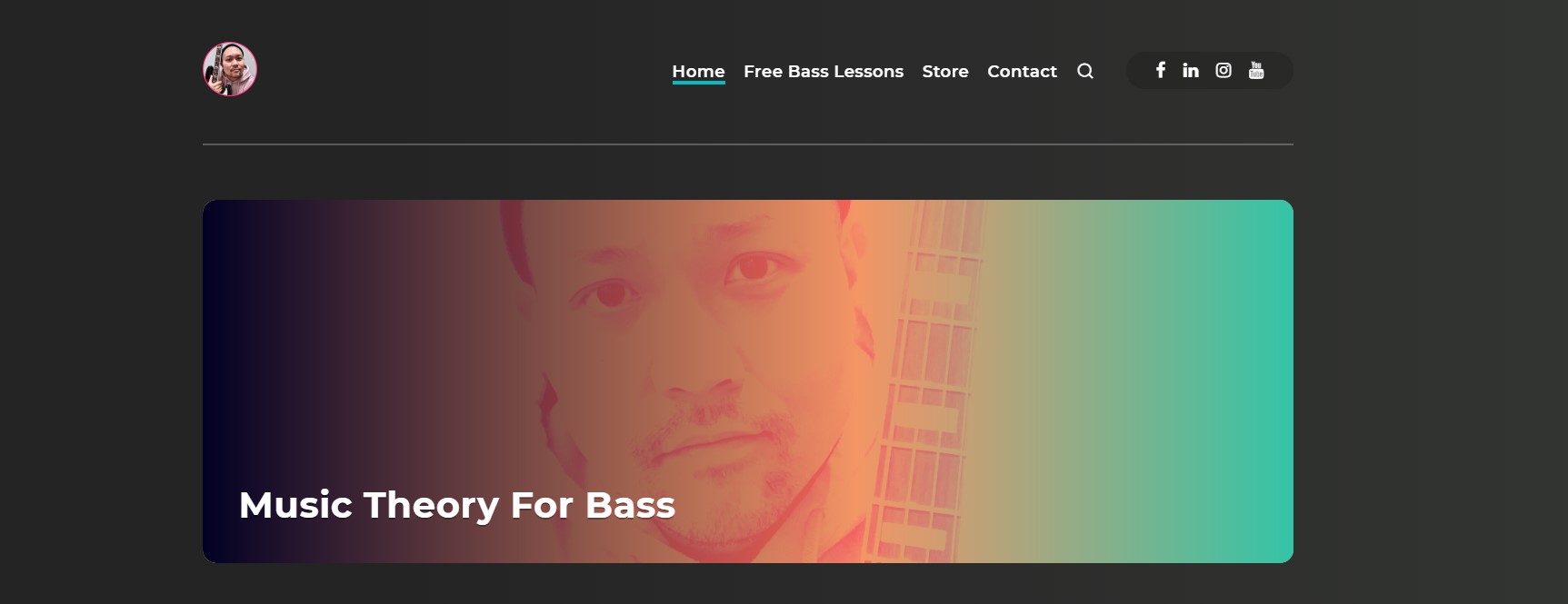
Lousy word play aside, Posido Vega is a great bass instructor who has been present on the Web in one form or another for a long time and always providing excellent content. His Youtube channel is simply awesome, and I really used to like his old written materials on Mutant Bass. However, he now has a new virtual home.


In order to reach it, simply go to posidovega.com and enjoy many free lessons that you can find there. The thing I dig about Vega's approach is the way he gives a holistic view of the topic at hand. Namely, you will hear the underlying theory explained in a very accessible manner, see and hear the music examples, while also receiving good exercises to work on, in order to get the material under your fingers and into your musical vocabulary. 

The subjects of he lessons are varying, so there is always something useful to chew on for your benefit. Remembering his former instructional efforts and products, I certainly hope he will keep providing us with new lessons and great learning opportunities. 

Monday, February 8, 2021

A Giant Is Gone

 I have to admit, it is with a heavy heart that I have received the news of Jim Stinnett's passing, following a series of heart-attacks. Besides being a true giant of bass education, Jim was a great and accessible gentleman ready to offer sound advice and helping hand, always smiling and exuding joy of life. This blog has already featured some of his brilliant teaching materials, and certainly will do some more in the future. 

...and those who knew him

After an illustrious career as a professor at the Berklee College of Music, preceded by years of music teaching done from genuine passion, it is no wonder Stinnett was able to convey important music principles and concepts in a way that few are capable of, and has produced dozens of great bassists over decades. 

If you are still not acquainted with his teaching style and lessons, I wholeheartedly recommend you visit his Youtube channel and see for yourself what excellent instruction looks like. Once you see how Jim was conducting his classes, you can't help envying the students who had the opportunity to learn from him in person on regular basis, and on a personal level, I feel privileged to have been able and established even a modicum of personal communication with such an inspiring person, one of those whose mere presence had enriched the lives of the people whose being was graced by sharing the same field of passion and/or path through it.

Rest in peace Jim, you will be missed and remembered.


Saturday, January 9, 2021

Theory in practice

 Bass players are an interesting lot when it comes to having wider and deeper knowledge of overall music, in its wider theoretical implications and practical applications. Of course, there is a continuum, but it often looks as if there are two (those who also act as the lead singer are excluded) categories that gravitate toward the opposite ends:

1. those listening only to drums and acting as the proverbial dummy of the band;


2. those who are actually the most educated/knowledgeable members, thus often acting as the main composer/arranger (John Paul Jones anyone?) or music directors of the band. 

I have very often seen or heard bass players looking to "outgrow" the first category, and therefore asking for the good books or other resources of music theory for bass. And there, to me, lies the problem - there is no such thing as the music theory for bass...or any other specific instrument. Music is music, and while different instruments may have different roles within ensembles of various sizes, they should all be able to speak the same language, in order to communicate effectively. Seeking the instruction that applies to bass is cutting yourself short of al the benefits that can be reaped with an unhindered approach as willingness to step out of your immediate comfort zone by learning music in a more universal manner. 

Hm, OK, how do we alleviate this problem? Well, by engaging in a well organized and comprehensive study of music. Now, a lot of self-taught musicians will cringe at the mention of the term theory, and think of it as something utterly boring and probably the bad voodoo that will rob them of their creativity and "soul" in playing. Although possible, depending on the instructor and the student, neither is necessarily true. I have already discussed some resources that deal with most immediate aspects of theory in a practical way for our instrument, and there are others in printed format that will be reviewed in the future posts, but today I would like to point the readers to an exceptionally well done online presentation. 

While I definitely prefer the book format as the means of "packaging" knowledge, sometimes there are simply better ways to efficiently convey information. As a great example of this, Clive Cockburn has made a website that offers a tremendous way to learn music in all its practical aspects in a very effective and practical fashion. 


The Contemporary Music Course is exactly that - not a bunch of tips and tidbits thrown together in random order, but rather a true step-by-step teaching of elements that will help you understand things you have been doing already on your instrument, as well as show you how to take your craft as a musician (see, I didn't say bassist) to a much higher level. 

How does he achieve this? Cockburn uses the video format to present his lessons, just long enough in duration to say what needs to be said, so you don't nod off, and then provides assignments in additional PDF materials to help you put what you have learned to practice. I especially like the fact that he integrates ear training with theoretical foundations, hence providing a deeper understanding of the curriculum.

Speaking of curriculum, it starts with two levels of fundamental elements, titled Language of Music, then proceeds through another two levels of Chords and Harmony, adds the treatment of rhythm through the lens of actual band practice in the Kit Drummer. After that, the course goes into that music director/arranger territory mentioned earlier via the chapters on Rhythm Section and Horns, Orchestral Harmony, Two Part Harmony & Counterpoint (gold for those looking to play more melodic bass lines!), Arranging Notes. To crown the course, the author gives special treatment to making/recording a Rock Session Project, including the writing of the song, preparing a lead sheet, rehearsing it etc. 

And now comes the cherry on the cake! While the annual membership for the entire course normally cost around $99, Cockburn is currently offering it for free (no login required), while the Covid pandemic is still at large. 

There...no excuse to skip this excellent offer!
Wednesday, December 23, 2020

Isolated bass...lost opportunity?

 Besides music, and bass in particular, my other (the first, as the matter of fact) is martial arts, and I have noted a strange disparity of how instructors in both fields have tackled the problem of staying put in our homes, without access to our regular "working avenues" of training and gigging. Namely, the number of martial art coaches and instructors who have offered either individual or group sessions via Zoom or similar live streaming outlets has been staggering. With music professionals, not really. Maybe it is because in case of musicians online teaching through live sessions has been a rather normal thing for quite some time, even before the pandemic outburst. 

However, my impressions is that the top echelon of performing professionals has missed a good opportunity here. See, the Berklee bas department did do a few events of the panel-discussion kind, but in all honest, those weren't much educational in terms of specific material or approaches to practicing. The thing is, hosting an online conference with a similar attitude as doing a clinic can be beneficial in several ways. 

To begin with, there are a lot of people out there who would love to have lessons from the top-level "so and so" musicians, but as the potential clients they are either intimidated or thinking there is no way those payers would even consider giving lessons. Conducting a free or affordable online clinic is  great way to show that they are accessible as instructors, and also to demonstrate their teaching chops. Here is a good example of how it can be done - Phil Mann did a series of lessons through Facebook live streams, and later put them on his Youtube channel With Bass in Mind


Adam Nitti is another monster player who has recently started doing similar sessions, with his excellent clinic on ear training. Choosing to do it via Zoom had the advantage of attendees being able to react immediately and establish good rapport, with feedback from both sides. On the other hand, just like the previous gentleman, Nitti is a veteran music educator in parallel with his recording and performing career, so he understands the need to keep in touch with his audience. 


As he matter of fact, even the rare cats that are actually already fully scheduled with their private lessons have understood the value of such public events. Anthony Wellington of the Bassology fame. The man who does 10+ private sessions on a daily basis still offers these opportunities for the potential clients who cannot get in queue or pay his regular fees. That helps spread the word and make sure he will never run out of work. 

And also...well, that's about it. I don't know what it is that makes the bass professionals shun those avenues of work, and that's a shame. I was hoping to be able and see some of them teach in this format, but it wasn't meant to be. 

Or maybe I am wrong and uninformed about such events taking place, in which case - please correct me!

Saturday, October 17, 2020

School time - Tony Grey Bass Academy


As much as I really, deeply love books as a source of music instruction, this is the 21st century after all and various online school and courses are the go-to places for all kinds of education, so playing bass is no exception. While still nowhere near the amount of instructional material available for guitar (or drums), there is enough bass dedicated options in the World Wide Web to cause hardship when attempting to use the one that would be right for you. If that is the case, let me try and offer some help!

Speaking of the online schools, I have always been skeptical of the term “academy”, but the website presented here is probably the most deserving of such title of all. Tony Grey’s has already been mentioned in this blog, but the simple fact is that as great as his book is, it contains just a fraction of the material offered in the Tony Grey Bass Academy website.


There are several elements working in conjunction that make this resource excellent. Obviously, the sheer amount of the material is staggering, but there are even “heftier” ones out there. The instructor’s expertise and professional background are also undisputable, but again, some of the other instructors are probably even more impressive in this regard. Visual design and ease of use are of the top shelf level, yet, certainly not the clear winner… OK, so what is it then!?

The aspect that takes the cake, and makes the TGBA my favorite (even among a few other I deeply like) is its methodology of presentation and thorough lesson plan. Being that my day job is a school teacher, there is nothing that speaks so sweetly to me as a well-though, expertly crafted, and skillfully taught curriculum. On top of that, Grey puts a premium on helping his students in figuring out how to organize their practice sessions in a manner that would be most conducive to achieving the desired results. 


Not only is the practice planning the first item on his default teaching agenda, but he will give all the newly joined students a free personal lesson/session to address the topic. Besides that, the academy has a forum reserved for the members, where Grey regularly addressed all the questions and clarifies any doubts about the lessons, if the students have any. As an instructor, Tony is a mild mannered, soft spoken gentleman, who will spare you the TV infomercial over the top sort of banter, and will instead focus on the details of the material being taught and how it will help you become the best player you can. And detailed it sure is! The academy lessons are done as videos with graphics where needed, supported by PDF files of written notes and transcribed music examples from the videos (no tabs, but fingerings indicated), as well as backing tracks for your practice. Here is an example of his teaching:


Now, the membership fee, while not among the lowest on the ‘Net, is more than fair if you keep in mind everything you get for it. Many other people strive to give the impression of a great deal, with a bunch of so-called bonuses thrown with the main offer, but the fact is that you probably won’t even look at those more than once. The Tony Grey Bass Academy, on the other hand, is founded on a premise of sincere care for the students’ progress, and conceived in such a manner that you will keep coming back and referencing its material regularly to get the reap the full benefits from learning.

Finally, Tony’s own personal story of learning music is the one of overcoming obstacles and dealing with doubts that many of us “average Joes and Janes” face quite frequently. Learning about it will probably reinforce your confidence in the material and the man teaching it, this further inspiring you on the path of musical development. 


Tuesday, September 15, 2020

Youtube gems - Everythingbass

I was thinking of having another post with a list of favorite resources within a certain medium, but since Youtube is such a vast and dynamic one, it seemed like a better idea to focus on one feature at a time. So, here we go…

Today’s installment is dedicated to the relative newcomer, meaning the channel has only been around for a few months, but Dale Titus has certainly been around the block quite a few times, including the mention on this blog. He earned his instructor stripes as a teacher at BIT and the author of a number of articles in Bass Player, so no wonder that Everything Bass is a very nice collection of videos on several topics in bass, neatly presented in “episodes”, so you can follow a particular subject of choice more easily, if you would like to focus on that aspect of your playing/practice. There are series on technical domains (slap, tapping), overall musicianship (fretboard familiarization, guided improvisation sessions), various professional tips etc.


What especially appeals to me in Titus’s approach is the balanced treatment of a topic at hand – he is neither stingy nor overwhelming. The videos are organized so that the main idea and the purpose are clearly explained, and then demonstrated through a couple of exercises and their variations. That way, the viewers aren’t left in dilemma about the meaning of what they saw, nor are they lost in trying to figure out what is the really important part of the smorgasbord of material unleashed on them. In other words, Titus inclines towards the depth of instruction, over the breadth, but the scope is attained through the continuation of the series of videos on whatever the subject is.

As the matter of fact, balanced is probably the single word that best describes the overall impression of this Youtube channel. As a video educator Titus is neither annoyingly imposing, nor monotonously pale; the exercises are challenging enough to take some dedication, and realistically attainable, so you are not discouraged…

Finally, if you have questions or something to say in the comments section, Dale actually reads them and is quick to respond. All in all, what we see here is the instructor who genuinely cares about offering the kind of contents to truly benefit his audience.


Sunday, August 23, 2020

Step by step - day by day

 What is the biggest challenge before most musicians, particularly those in earlier stages of honing their craft? Judging by most indications I have seen so far, it is the organization and adherence to daily practice. It is understandable - first, you have to figure out what needs to be done, then decide on how to schedule those topics, how long to say with them etc. With so many variables, no wonder a lot of people end up noodling instead of running a specific and targeted practice sessions. 

Well, fortunately for us bassists there is a great way to overcome those obstacles. Jim Stinnett comes to rescue! Jim is a professor at Berklee College of Music, with decades of teaching practice and dozens of respectable alumni, who can attest to the success of his methodology. To get a glimpse of his approach to teaching bass you just need to visit his excellent Youtube channel Real Bass Lessons and peruse a couple hundred (!!!) tutorials he has there. 


However, the main subject of this post is a phenomenal series of books Jim published, titled Daily Practice For Bass. As the title suggests, what we have here is an actual practice plan, laid out and organized for all those who are willing to dedicate 45 minuted of their day to follow the instruction. Stinnett has already done all the hard work, mentioned above, all you have to do it is follow the plan...simple as that! 


Each book opens with a succinct explanation of how to use the material, then covers four weeks of practice, and includes all the main ingredients: technique, reading, harmony, ear training, fingerboard knowledge. And the brilliant thing is that all of them are presented through actual musical content - technique and fingerboard command are built via scales and arpeggios, ear training via transcription of music phrases, harmony via walking lines and basic chordal shapes, rhythm via Motown-type and funk grooves etc. To make everything even more fun and enjoyable, there are backing tracks to be downloaded from Stinnetts website, so you can hear the musical context for what you are doing. 

Since the work is packed in daily sessions of 45 minutes, there is enough time left for other things you may wish to do on your instruments, whether it is jamming with your favorite songs, learning new ones, working on your tapping and slapping, or... In short - perfect solution!


OK, I would actually like if Jim had some sort of reading practice set for every single day, because in my opinion that segment cannot be skipped if one truly wants to have it down cold. But, let that be a subject for a later post. 

Now, the nicest part is the price. At $18 per book/volume (plus shipping), it means you are only paying less than 65 cents per lesson! At the moment, Jim has 13 books out, so you have more than a year's worth of material, with guided practice method - step by step, day by day. What more can you ask for?

Jazz bass lesson from one of the greats

 In this day it is sort of hard to get pass Youtube when it comes to finding good instructional value, so I couldn't skip the opportunit...